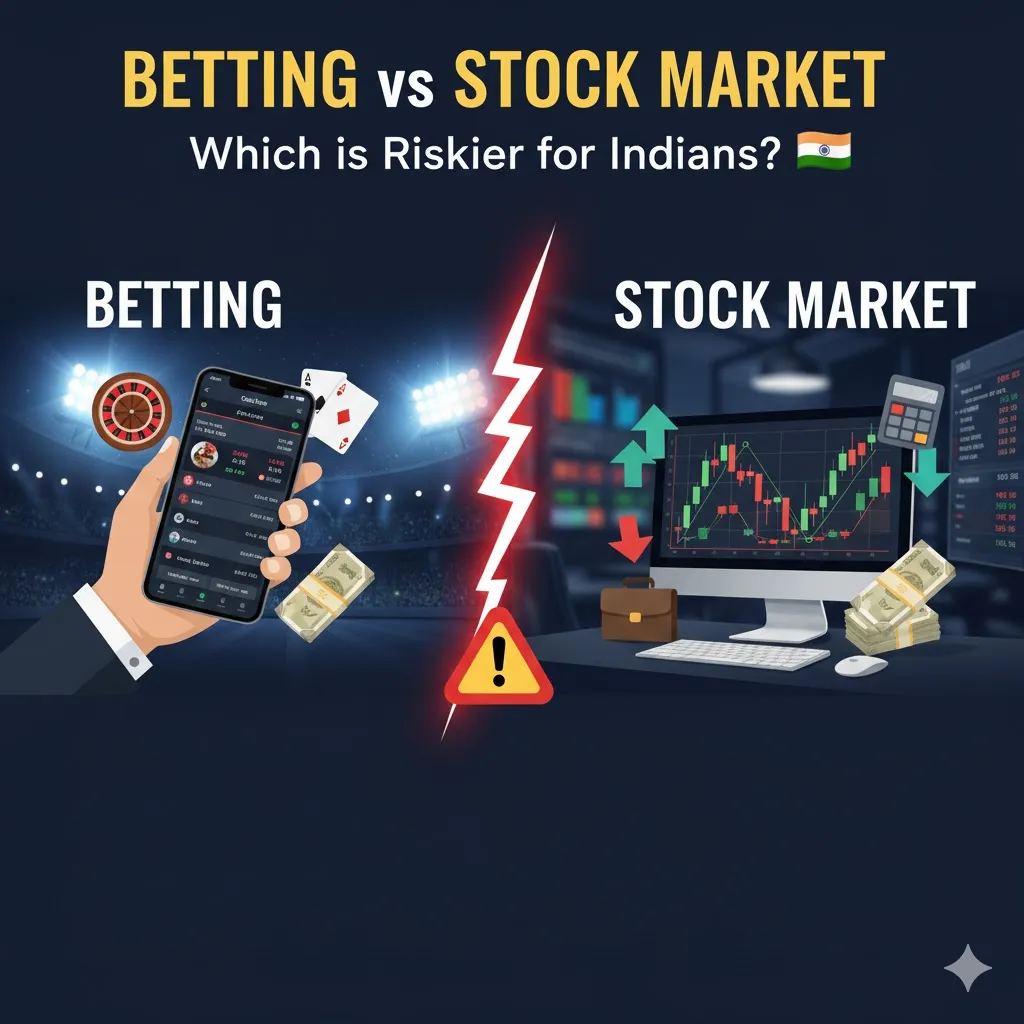
Betting vs Stock Market: Which is Riskier for Indians?
So, the two main industries vying for the interest and capital of the regular Indian in this digital age are the high-stakes world of stock trading and the electrifying realm of online betting India.
Both involve money, risk, volatility, and the hope of a big payoff. Yet, they are fundamentally different creatures. On one side, you have the structured, regulated ecosystem of the National Stock Exchange. On the other, you have international cricket betting apps operating in a legal grey zone, promising instant gratification.
For those trying to grow their wealth or simply seeking an exciting way to deploy capital, a critical question arises: Which is riskier for Indians-betting or the stock market?
The answer does not lie just in the numbers, but in the nature of the activity, the regulatory framework, and most importantly, the psychological approach of the user. Let's break down this complex comparison.
- Nature of Risk: Skill vs. Luck
The crucial distinction between the stock market-that is, investing-from betting, or gambling, comes in with regard to expected value and the role of skill.
The Stock Market: An Ownership Claim
- Risk Profile: Calculated and manageable. When you purchase a share, you become a fractional owner of a business that generates revenue. Your returns are pegged to the long-term performance of the company and the economic cycle in general.
-
Role of Skill: Dominant. Long-term investing requires research, financial analysis, knowledge about macro trends, risk diversification, and patience. While there is more luck associated with short-term trading, true investing is a research-based discipline.
-
Expected Value (EV): Long-term positive. The stock market, specifically the benchmark indices, has over time moved upwards, implying a positive expectation of return for disciplined and diversified investors.
Online Betting: A Zero-Sum Game * Risk Profile: Uncalculated and absolute. Betting is a zero-sum game played against the house, (gambling platforms India) or other bettors, in an exchange. For every winner, there is a loser, and the house always takes a commission known as vig or juice.
-
Role of Skill: Limited. Though knowledge helps in betting on sports like cricket, the final outcome is determined by random, uncontrollable factors: a dropped catch, a sudden shower of rain, or a poor decision by an umpire. Even the most knowledgeable bet cannot escape chance.
-
Expected Value (EV): Negative. Since the house always takes a commission, the mathematical expectation of winning over a large number of bets is invariably negative. This basically indicates that the odds are stacked against the player.
Verdict on Risk: Betting, by its very nature, is riskier because the financial outcome is primarily determined by chance, and it operates with a structurally negative expected value.
- Returns: Quick Profits versus Long-Term Investment The risk profile is drastically altered by the timeframe of returns. | Parameter | Stock Market (Investing) | Online Betting (Gambling) | | :--- | :--- | :--- | | Time Horizon | Long-term (3 to 30 years). | Short-term (minutes to hours). |
| Nature of Return | Capital appreciation, dividends, compounding. | One-time fixed payout based on odds. |
| Recovery of Loss | Possible. You can hold assets, exit partly, or diversify to recover losses over time. | Impossible. Once the match or event is over, the capital is lost permanently. |
| Wealth Creation | Yes. It is a proven mechanism for building inflation-beating wealth. | No. It is a recreational expense that, at best, provides temporary wins. |
The stock market applies the principle of compounding: reinvesting profits to make future returns. Betting, even with a massive win, does not allow for such a mechanism. It is a flash-in-the-pan event. High volatility and the fast rush of adrenaline in betting mask that the risk of losing the entire stake is constant.
- Regulation in India: SEBI vs. Online Betting Laws
In the Indian context, the biggest factor influencing safety and accountability is the regulatory body overlooking the activity. The Stock Market: SEBI's Shield
The Indian stock market is regulated by the Securities and Exchange Board of India (SEBI).
- Oversight: SEBI is a strong, central regulator enforcing stringent regulations concerning transparency, insider trading, and investor security. Brokerages must register, while operations of capital markets follow clearly defined procedures. (External Authority Link: Check SEBI's official investor protection guidelines https://www.sebi.gov.in/ rel="nofollow noopener")
• Grievance Redressal: There are well-defined channels for grievance redressal against brokers or exchanges. * Safety: The whole transaction cycle, from opening a Demat account to placing an order, is legally compliant and secure.
Online Betting: The Legal Grey Zone
Online betting, however, falls into a much more fragmented and ambiguous legal framework.
-
No Central Regulator: There is no SEBI-equivalent for online betting India. Betting is a state subject, and though some states permit lotteries or regulated games of skill, the majority of the legal betting sites India are operated by offshore operators (Curacao, Malta, etc.).
-
Ambiguity and Risk: Though using an offshore site usually is regarded as a "grey area" at the federal level, several states, including Telangana and Andhra Pradesh, have issued bans that extend to online gambling in all its forms. This ambiguity in the law places compliance risk on the user. (Internal Backlink Placeholder: link [Is Online Betting Legal in India?] → /is-online-betting-legal-in-india)
-
Consumer Protection: In case an offshore gambling platforms India refuses to pay out a large win, Indian users have virtually zero legal recourse or investor protection within the country.
-
Psychology: The Thrill of Gambling vs. Disciplined Investing
Both activities can become highly addictive if approached improperly, but the psychological drivers differ pretty substantially.
-
Betting: Taps into immediate gratification and the dopamine rush. It appeals to the impulsive side of the human mind, often leading to emotional decisions-like chasing losses-that are irrational and high-risk.
-
Investing: It speaks to discipline, long-term planning, and delayed gratification. Successful investors have to filter out short-term market noise and stick to a long-term plan that very often requires mental fortitude against selling in a panic.
When one enters the stock market to gamble on it-specifically, reckless day trading without analysis-the stock market becomes gambling. To the contrary, disciplined strategic long-term investment is the opposite of gambling. 5. Accessibility: Where the Risk Begins The ease of use afforded to us by technology has ironically lowered the barrier to entry for both, increasing the risk for the unprepared user.
- Betting Apps: The combination of powerful betting apps India and UPI betting sites has made transacting frictionless. With minimum deposits often as low as ₹100, a person can start betting on a cricket betting app in minutes. (Internal Backlink Placeholder: link [Best UPI Betting Sites India] → /best-upi-betting-sites-india)
- Stock Brokers: Discount brokers like Zerodha and Groww have made stock investing accessible via user-friendly apps, democratizing finance. However, opening a Demat account still involves a more rigorous KYC process, which serves as a slight psychological and administrative speed bump compared to signing up for a betting app.
- Responsible Approach: When to Invest, When to Avoid Betting
The stock market is a wealth-creation vehicle, while betting is an expensive variety of entertainment.
When to Engage with the Stock Market:
-
When you have a long-term goal, retirement or for the education of your child.
-
When one commits to research, diversification, and proper risk management-Stop losses.
-
You are using registered SEBI brokers and financial instruments.
When to bet: * As an entertainment expense, strictly with money that one can afford to lose. • When you understand the negative expected value. * When you set firm deposit limits and use self-exclusion tools on safe betting apps. If the amount of money that you are betting causes stress, relationship problems, or financial constraints, you have crossed the line from entertainment to problematic behavior. Responsible Betting Practices in India are a prerequisite for safe engagement. (Internal Backlink Placeholder: link [Responsible Betting Practices in India] → /responsible-betting-practices-india) Conclusion - Which One is Riskier for Indians? The comparison is clear: Online betting is structurally and mathematically riskier than long-term, disciplined stock market investing. * Structural Risk: Betting has adverse expected value and does not enjoy any centralized effective regulatory protection in India. You are betting against the house, and the house always wins in the long run. * Controllable Risk: A volatile stock market still offers ownership, a positive long-term expected value, and a robust regulatory shield in the form of SEBI. It is a high risk only when users approach it with the same impulsive mindset for short-term gambles that they do on a **cricket betting app. For the average Indian seeking long-term financial security, the stock market remains the vastly safer and more effective path to wealth. Betting has to be seen as a form of entertainment with an unavoidable price tag.